Monday, August 08, 2011


Today was my first day back to school this summer. Sure, I’ve stopped by to visit, check the mail, just pop in, but today was the day I started putting my classroom back together.

The rearranging of the furniture, the digging out the textbooks, the hanging of the posters, is all really symbolic of something bigger.

I spent a lot a time today just sitting at my desk, pondering, looking at the tables, the chairs, thinking about how I wanted them arranged, what the final overall plan was to be. Having been in this same classroom for 10 of the past 16 years, I have some idea of what works and what doesn't. But every year is different. Each group of students is different. I am different each year.

Symbolically, it is a starting over. A clean slate. A new chance to make a difference. Where I put the tables matters. But more importantly, the attitude I start the year with matters. My attitude sets the stage for the learning (or lack thereof) that will occur within those 4 walls during the 2011/2012 school year.

Someone on a listserve once commented: We are but part of their journey. I hope that can be my mantra for the year, with students, parents, and other staff members. As I move tables, write names in textbooks, print parent letters, and plan those first few days of class, I will strive to remember the impact I have on their individual journeys, and even more, strive to make that impact a positive one.

Wednesday, August 03, 2011


Secretary Duncan thinks teachers should be paid more. Great! $60,000 to start with a potential for $150,000 is way ahead of the pay scale in my district, so I’d be all for it!

Wait, there’s a catch? Big surprise….

In the first place, Duncan is just shooting off at the mouth, with no real green stuff to back his proposed generosity. With districts, states, schools everywhere, cutting way beyond bare bones, down into the nitty gritty necessities, laying off teachers, eliminating critical programs, making desperate attempts to keep the doors open and the electricity and heat on, the likelihood of tens of thousands of dollars in pay raises are almost a joke.

But the real catch? Duncan wants the money tied to test scores. As if most teachers would/could do anything differently to raise test scores even if they were paid a million dollars for each proficient score. (Oh.. wait, they can and have done something – CHEAT. But that’s an entirely different issue.) The reality is, there are too many great teachers, doing exactly the BEST they can do for their students. Circumstances beyond the classroom teacher’s control impact scores almost as much as their teaching. These teachers ARE giving 100%, or even more, to make sure their students get a quality education.

The few bad apples tend to taint the pool for everyone. The public focuses on that one bad teacher they had in school, that one difficult teacher their child had, the rumors they’ve heard about what goes in this classroom. I acknowledge changes, drastic changes, need to occur in some classrooms. Some teachers are not meant to be teachers. They don’t know their content. They are incompetent at getting information across to students. They refuse to follow the curriculum. They are mean spirited and hateful. But, these are not the norm, but rather the exception to the majority of teachers in the teacher pool.

I’d love to make more money teaching. With 16 years experience and a master’s degree, I just barely break the $55,000 mark. With all the extras being docked to my pay, the 3% mandated to pay for retirements, the extra 10% towards my insurance, union dues, etc… the reality is much less than a $55,000 starting point. I don’t see cost of living raises. I don’t get extra if I work extra. I do fork out a lot of money for classroom incidentals, materials for students who can’t afford them, or whose parents refuse to provide them. I buy food for students who are hungry, fund field trips for those who don’t have the funds. Ask any teacher and they will give you the same story about out of pocket ‘expenses’.

But paying me more won’t change anything about the way I teach, the quality of education I provide for my students. I still won’t be able to get them to school on time every day ready to learn. I still will struggle to compete with video games, online chats with friends, music videos, and other distractions that appeal much more to the average adolescent than the Pythagorean Theorem or inverse functions. I will still struggle with parents who think because I expect their child to come to school, do their work and be respectful, I am picking on their child. I will still struggle to overcome the child who is being abused and/or neglected at home, who carries that weight heavily on their shoulders.

Worse yet, offering to paying the ‘bad’ teachers more won’t change their classroom practices either. If they had the skills to teach well, they would already be doing it. If they had the true desire to change the lives of their students, they would already be doing it.

Some of the marginal teachers might be inspired to try a little harder to reach their students with a pay increase, but this small percentage of teachers would make such a small impact on overall student learning, it seems not worth the price. The bottom line is, good teachers are good teachers, regardless of their pay. Bad teachers are bad teachers, regardless of their pay.

Pay teachers more because they deserve to make a professional wage. Pay teachers more because they have one of the most important jobs in the world. Don’t base their pay on an arbitrary test score that has been proven repeatedly to be inaccurate and invalid. Don’t base their pay on a test score that is partly beyond their control.


So thanks Duncan for your little dangling carrot,

but no… I don’t think so.

Thanks anyway.

Tuesday, July 26, 2011

When a link to an article titled How to stop discipline issues forever popped into my Facebook feed, I clicked on it, obviously. Discipine, classroom management... those topics always seem at the forefront of what teachers need/want to solve, learn more about, and seek advice on.

The ASCD Edge blog post by Mark Barnes was interesting, if brief and incomplete in its how-to methodology. But the basis for the commentary was simple - get students focused on something that interests them and discipline problems will disappear.

In theory, I agree wholeheartedly. Engaged students are just that - engaged. They are focused on the project in front of them, and will give it their all to completion. Make it fun, make it interesting, make it relevant, and students WILL do it.

Let's step away from theory and into the real classroom though. Some subjects lend themselves more readily to project based learning - social studies for example comes to mind. Learning about places, people, cultures, all are easily student driven, given the right guidelines and guidance. Tell the kids what their outcomes should be, and set them free to learn and explore. Just some close monitoring, prodding, guiding, and most students will meet the objectives set forth.

Other subjects aren't so easily conformed to project based learning, at least in my mind and experience. Math is the worst it seems, the most impossible to allow students to direct themselves. With a subject so skill based and sequential by nature, allowing students the freedom to design, explore and meander mentally through the material seems fraught with disaster.

Reading and writing also seem to require a bit more direction from an instructor, giving guidance, advice and skills along the way. Much of the 'work' can certainly be individualized to meet the needs of students' interests, allowing them much freedom and leeway in the choice of reading materials and writing topics.

Anytime someone advocates allowing students to direct their own learning, I approach the thinking with caution. I'm all for choice, knowing choice gives students power, which is an effective tool in engagement. But I also believe students need to attain a certain basic set of core skills and knowledge in education. I don't see the average student motivated enough to accomplish this on their own with little guidance/instruction from a teacher.

Wednesday, July 20, 2011


There's a lot to be said for being 2 years old again and being able to dress up, putting on an entirely new persona and becoming someone new for a little while. This morning as my granddaughter donned the princess gown and high heels, teetering around the house slipping and trying to balance, complaining about how scratchy the gown was, I couldn't help but smile obviously, but I was also a bit envious. When 50 is knocking loudly on the door, the reality is you've now decided what you want to be when you grow up. Sometimes, I jokingly say, "When I grow up, I want to be a landscape architect" or "When I grow up, I want to be a geologist" bemoaning the loss of the options. In reality, I love being a teacher and even given the chance to start over, I would likely choose the same path.


For many of our students though, they can't see past today to envision their own possibilities. Talking with colleagues yesterday, we talked about the career paths of our own children, the choices they've made, the choices we think are right for them, and the downfalls of our high school's preparation of students for making those choices. Cuts in education have led to few vocational programs being offered. A one-size-fits-all curriculum prepares, or tries to prepare, all students for college. In reality, many kids aren't college bound, for a variety of reasons. But does school really show them other options, explain to them the possibilities, help them explore the many other worthwhile opportunities out there?


The two colleagues I was talking to have 6 children between them. I have 2 of my own. One of mine went to college, undergrad and grad school, right out of high school, and has a lucrative career in the avionics communications field. My younger tried college for several years but it wasn't for her. After a variety of jobs, she has gone back for a certificate in phlebotomy, a much shorter, cheaper option than a 4 year degree, but one with a reasonable salary and benefits. Of the other 6 children belonging to the my colleagues, only 3 are out of high school, with 2 in college, and the other recently joining the Air Force. One of the others will be a senior in the fall, with no clear after-high school goals in mind yet. While he is a great kid, a bright kid, a very likable kid, he probably isn't college bound. Does that mean he is 'less'? No, it just means we need to help him find HIS path whether it is some type of vocational training that will lead him to meaningful, gainful employment, or some other option. His younger sister, a sophomore, has already set her sights on the medical field. We need to help her focus her dreams and prepare her for those. Little brother is still in elementary, but I can already see him working in the Department of Natural Resources, either as a conservation officer or fisheries/wildlife biologist.


The point is... all kids are different, with different educational needs, different paths they will choose in the future. We just need to make sure we, as educators, are not only preparing them for these paths, but telling them their many varied options instead of assuming they will all go to college, and teach them accordingly. For all we know, someday, that young lady WILL become a princess... or a geologist.... or a landscape architect... or maybe 'just' a grandma :)

Saturday, July 02, 2011


Up early on Saturday morning, enjoying the peace and quiet, looking out my patio door, I see my"kid garden" along the patio edge, full of gifts of various flowers over the years. I'm always amazed at how these flowers always seem to thrive. This lily is one of my favorites, I must admit. The first year, it was a gangly, spindly plant that didn't look as if it would survive the ride home from school. But I planted it alongside the other mismatched flowers that I've planted over the years, gifts from students, plants that didn't fit somewhere else in my 'grand scheme' of gardening. These plants hold a place of honor edging the patio, instead of tucked away hidden where no one might notice them.


Over the years, this lily has managed to survive. It is no longer gangly . Instead it is a glorious bush of blossoms - 18 open this morning, with many more buds waiting for their turn to shine.


My lily is like a middle school kid.....

they come to us, a little mishapen, a little gangly, not all that gorgeous on the outside at times...

but filled with potential...

just waiting to be planted in a place of honor....

wanting and needing to be tended and cared for over the years....

until they bloom magnificently into adulthood......


Thank you all my middle schoolers who have given me plants over the years. I've enjoyed watching the plants grow and mature and blossom, just as I've enjoyed watching you do the same.


Wednesday, June 29, 2011


It's summer vacation time, strawberry jam making, working in the garden, baking, cleaning.... all those things that I never seem to get done during the school year. All those things take me back to my growing up days, way back when. Both sets of my grandparents lived a 2 hour drive away. While I didn't spend tons of time with either pair growing up, I do have fond memories of being at both their homes.


My dad's parents lived in town, on the quintessential tree lined Southern street, complete with huge azalea bushes flanking the sweeping front porch where we sat in the evenings in big white rocking chairs nodding to neighbors strolling by, listening to crickets chirp, and dripping sweat in the Mississippi summer heat.


My mother's family lived in the 'country'. In reality, they lived on a huge farm, a commercial farm where I remember long chicken/turkey houses of terrifying and smelly poultry, catfish ponds, pastures of beef cattle, and gardens of epic proportions. Summer days there were fun, filled with work and play, whether it was shelling butterbeans on the porch or playing baseball in the cow dung filled pasture, there was always something to do. When I make jam or my other 'farm' chores, I am transported back to those days.


In today's educational arena, I wonder if we aren't ready to go back to those same days. When I was growing up in Mississippi, school days were filled with work and play, just as days on the farm were. My memories of school don't include computers or air conditioned classrooms. They don't include teachers who coddled us, or parents who came in to school to criticize those teachers for disciplining us when we were disruptive or insubordinate.


Way back then, we went to school, we did the work, we didn't ask why or when we'd ever need to know this. The teacher said we needed to do the work; we did it. We learned, we memorized, we practiced, we failed, we were challenged, we learned. There was never even a thought of being disobedient. We knew any thought of that would be a trip to the office, followed quickly by a phone call home, followed by a swift paddling to the rear.


But school wasn't something we dreaded, or were stressed out about, or tried to avoid. We loved going to school. It was where we met our friends, where we laughed and played at recess, where lunch time was spent eating homemade food made by the lunch ladies who dished out those meals with a smile and a hug when needed. In our classes, we worked hard, but we did fun things as well. OK, to us, they were fun! We made posters; we made models out of clay; we played games to review for tests; we challenged each other in debates; we wrote poetry; we recited poetry and lines of Chaucer and Shakespeare; we dissected frogs and cats; we dressed up to celebrate learning about Mexico, eating spicy food and dancing the Mexican hat dance. Everyday was something new and exciting.


When we got home from school, we did our homework. There were no video games or even much on TV to distract us. There were no computers. If we wanted to talk to friends, we had to call on the phone. But those phone calls were AFTER homework and chores were done.


If we didn't do the work, we failed. Period. End of discussion. We didn't go onto the next grade. In high school when the credits became an issue, failing a class meant summer school..... so in reality, most of us didn't fail. The penalty was too severe. We did what was expected of us, at school and at home.


It seems simplistic I know.....


but what if.....


  • we could turn society around so that EDUCATION was the important factor for children again.......

  • if we could push video games and Facebook and American Idol and texting to the background.....

  • if we could have teachers who knew they were in control of their classrooms, with support of parents and society.....

  • if teachers taught what was supposed to be taught, because those expectations were black and white......

  • if students came to school excited, instead of distracted.....

  • if moving up a grade meant you'd mastered the skills for that level....

  • if school was exciting and interesting, and students WANTED to be there....

  • if...............

Tuesday, June 21, 2011

After much thought, debate, denial and out and out refusal, I have decided to throw my hat into the ring for the middle/high school principal position at my school.


, I said no way.. absolutely not, no way… too much uncertainty, too much baloney, too much too much…. Not for me…


However, we all have our weak moments, our back pedaling, our think it through again moments, and come to different conclusions, even on such heavy topics.


I’ve spent some time talking to others from my district, thinking about the criteria for this position. What WOULD the perfect candidate look like? What philosophical beliefs would s/he need?


As the conversations continued, I became more and more intrigued with thought of accepting such a role. I argued with myself. I argued with others. And in the end, I completed the application and hit SUBMIT.


Am I the most qualified? In some ways... probably so.

I have a unique perspective on the teachers in our district, their strengths, their weaknesses, their abilities to change and adjust. My own children graduated from here with a strong background that has prepared them for the next steps in their life journeys. I've seen the school as a parent, and through the eyes of students. I've seen it all, the good, and there is plenty of good... I've seen the bad... and there is bad to be fixed, as in any school.


I've had the pleasure and honor of working with several administrators, all of whom had different leadership styles- and I've learned from them all. What is that Jimmy Buffett song... "read dozens of books about heroes and crooks, and I've learned much from both of their styles..." Each and every administrator and teacher I've ever worked with taught me much about how TO do things, and how NOT to do things. I like to think I can combine all this information and create a persona all my own in that position.

I know the people, the rules, and what changes must be implemented if our district is to move forward. I know the games, the opposition, and who will be on my side.

In other ways, I wonder if someone from outside our district might be a better candidate, someone who would come in with a clean slate, with no preconceived notions about how it has been and ought to be. But then, I wonder how long would it take that orientation process to take place. It seems we go through administrators awfully quickly. Do we need just one more on the roster? Or would it be better to have someone rooted in this community, who will stick it out no matter how rough the waters get?

I don't have all the answers.. all I have is an excitement.. thinking of the possibilities... of being able to implement a true SHARED LEADERSHIP model of administration... of being able to be an instructional leader to those I admire and value most.... of learning with others as we move forward down the path.

Part of why I hesitate to leave the classroom is the students. They are and always have been, the BEST part of my job. But as principal, maybe I can continue to help them learn, grow and become the responsible adults, contributing members of society I know they can be...Maybe I can reach more students this way?

For now, I have my fingers crossed I get called for an interview... wish me luck.... or think me crazy....

Tuesday, June 07, 2011


Technology is great when it works right but it seems more often than not, little gremlins are sneaking around, doing their evil to make anything and everything go wrong!


Today is our first half day of a three day stint for exams. A teacher called in sick. There were no substitutes available so I said I would rearrange my schedule and sub for him. (Being an inclusion teacher for much of the day, means my time is somewhat flexible, depending on what is going on in the classrooms I co-teach in.) I popped in the missing teacher's classroom to see what he had planned for the 100 minute block of time ahead. NOTHING... NOTHING!!! No lesson plans. NO NOTHING!! (We will assume with good will he was too sick to leave something??)


Class starting in just a few minutes, with 20 6th graders.... Most of my stuff is already packed and put away, and my brain is on last week fried overdrive. Think Pooh, think. A movie... that would be the easiest option. Not educational. Not curriculum linked. Guilty as charged. But honestly, it was all I could fathom at this last minute juncture.


Toy Story 3 is still relatively new, and such a fun movie. I quickly called my husband to run in to me. Projector hooked up, speakers going, movie in and queued up ready to go just as the little darlings walk in the door. They are excited! A movie!! That just doesn't happen and they think it is a wonderful way to end the year.


Movie is underway. All is well. *breathe* Then, the projector overheats and shuts off. Plan B. I quickly race to another classroom and steal back my projector and DVD player which another teacher had borrowed. In the process, I manage to disrupt a class of 8th graders taking their final exam as I drop the speakers on the floor. Race back to the other classroom. Try to get it going. Power issues.. what IS WRONG??? OK, that cord is loose. Fix that. Wiggle another cord, and another. Finally, we have picture. NO SOUND though. hmmm.... When I drop the speakers, that cord must have come loose. Click... SOUND!!! 15 minutes lost, but finally.. we are back in business.


End of class. Stop movie to get ready for next class. What's wrong now??? Oh good grief, somehow the DVD slipped out of tray loose into player. Shake it upside down vigorously until it falls out, but now the tray won't close. Oh for crying out loud.... Grab the teacher's laptop, hook it to projector. Racing against time. Nothing works. NOTHING WORKS. Oh... I forgot to hook the cord from projector to laptop. DUH. Hook up cord. STILL NOTHING WORKS. Starting to panic now.... function, F8. function, F8. NOTHING WORKS. NOTHING WORKS. I officially give up. I call the tech person who gathers from my panicked 2 second explanation of the last hour and half of events that I need her NOW. She races upstairs. Thank goodness, it didn't work for her either... that is USUALLY my luck. She uninstalls, reinstalls, works her magic. Has to restart computer. And then.. success :) We are up and running, just as the bell rings and the next group walks in the door.


WHEEEEEWWWW.... Gremlins. I swear. GREMLINS.

Monday, June 06, 2011


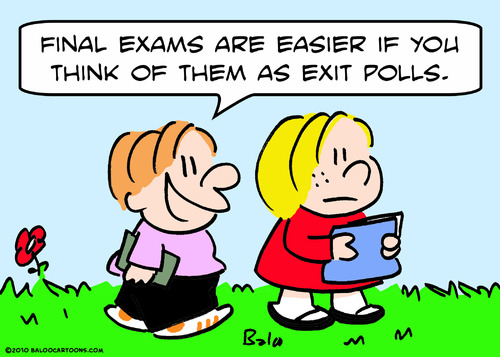
One more of the idiocies of school is final exams. Who decided that giving a test over 'everything you've learned' is necessary. In theory, if students HAVE learned the material, the teacher should know without a doubt the material has been 'asborbed' and doesn't need further validation of that fact. On the other hand, if the teacher isn't sure if they've really learned the material, does trying to convince students to cram all that junk into their brains at the last minute make sense anyway? Good students worry, cram and try to squeeze every last detail into their brains to fill in the bubbles on that exam. Once they put pencil to paper, the minute details dissolve from their long term memory, leaving behind on the real LEARNING that took place over the course of the school year. Less successful students don't bother with studying because they've found their niche in the process and are certain that last minute studying is futile at best. Final exams are a waste... a waste of class time which COULD be spent doing something exciting, engaging and worthwhile those last days of school.

Thursday, June 02, 2011


The netbooks are here, the long awaited netbooks ARE HERE. Woohoo... woohoo.... woohoo...


In some ways, this grant is a blessing. Now, *all* students 7-12 have a netbook in hand. No more worrying about signing up for the lab or computer cart. No fighting to scrounge up the missing laptops off the cart.


Of course, all students did not actually receive a netbook. Those with fines, without a parent consent, or those who choose not to, are netbook-less. Today, the first day for most students, some came without them already.


In other ways, this entire grant is a nightmare. While the grant's name (Broadband Technology Opportunities Program) suggests it will increase broadband availability in our region, in reality, it has nothing to do with that goal, even remotely. The grant has simply put netbooks into the hands of students, grades 7-12. That in itself is a lofty goal, and a potentially worthwhile one as well. Unfortunately, the students I know who have broadband at home, have a computer. The ones who did not have broadband before the grant handed them a netbook, will not have it now either.


Having netbooks at school will be great for many things. Incorporating technology regularly into the curriculum will become much easier. Hopefully, teachers will take advantage of this opportunity to find new ways to engage students in non-traditional ways. Unfortunately, no teaching training in technology integration was part of the program so for many teachers, the netbooks will not change instruction long-term.


For the immediate impact, students are so excited and busy surfing on Facebook, playing games, and Skype-ing with each other, they can barely contain themselves to be bothered with completing assignments. In particular, for students without broadband at home, this is a magical opportunity to catch up with friends who always get to play online.


We've jumped in head first without first testing the waters. We didn't take the time to teach appropriate computer usage, or acceptable classroom rules. Our filter system is yet to be upgraded so it is basically a free for all for students. As the school year winds down, and the netbooks are new and exciting, most teachers are just giving students free reign thinking by fall, the new will have worn off and we can start the school year fresh with a different approach.


I am excited to try and incorporate more technology next year. I just am skeptical until I see all the netbooks come back, in working order. Only time will tell.....

Thursday, May 26, 2011

One of my biggest pet peeves (If you read regularly, you know I have a LONG list....) is teachers giving students more work as punishment. Usually, this is a busy work assignment... some contrived worksheet to complete, some additional reading assignment, or whatever lame excuse for 'schoolwork' the teacher can think of off the cuff.


  • Teaching is about imparting not just content to students, but a love for the subject matter, a genuine interest to quest for more knowledge once the classroom door has been closed. In theory, teachers became teachers because they loved their subject matter so much they wanted to share that love with students. True teachers yearn to help mold new scientists, mathematicians, sociologists, writers... They want to see the learning process as it unfolds and awakens in young minds as they discover the excitement of new things. By giving the topic as a punishment the wrong message is sent to students. Now, writing, or reading, or whatever, becomes negative in their minds, something to hate and dread instead of something to yearn and quest for.


  • Punishment rarely accomplishes its goal. When possible, being proactive and keeping problems from occurring is much more effective, in all situations, but in particular in the classroom, than any after-the-fact punitive action. If your classroom is so out of control, giving additional busy work to keep the students 'occupied' is your only option for control, the problem is bigger than any punishment will solve. First off, many of your 'worst offenders' likely won't complete the additional busy work anyway, leaving it more of a burden for the 'good kids' who feel obligated to do anything and everything, while those you wish to punish will sit back and coast along, causing even more grief to the peace and tranquility the teacher is searching for.


  • Students know when the assignment is contrived and even the good students do not give these assignments their due attention. Any educational benefit you might have gained from the work, is lost to all. It is simply one more task to complete, one more mountain to climb. Likewise, teachers seldom even look at this work, making it even less meaninful.


  • Busy work assignments often aren't as 'punitive' as you think they are. Speaking as someone who did more than their share of writing "I will not talk in class" growing up, I quickly learned the fast way to completion. Write a column of "I", follow with a column of "will" and so on. If the process of writing "I will not talk in class" was supposed to make that statement stick in my head, the process was lost. Instead, I remembered, I-I-I-I-I-I, will-will-will-will-will, and so on, NOT "I will not talk in class." Students will find shortcuts to assignment completion, even the good kids. It really will be nothing more than busy work.


  • Fill your classtime with real learning, real engagement, real excitement. Then, your classroom management issues will dissolve, busy work won't be needed, students will be excited to come to class, and you will love sharing your enthusiasm and love of your subject with students and they will likewise love your class.

Wednesday, May 25, 2011

NOT ENOUGH MONEY IN THE WORLD!


I suppose at one time or another, most teachers consider making the move from classroom teacher to adminstrator. In the teaching profession, there are not many options for advancement and this is the logical next step. At one time, I thought I might want to be principal, and actually started working on my masters in adminstration. However, soon, I decided I really wasn't that dedicated to pursuing that option and stopped taking classes.

The classroom is where I belong, where I enjoy being, where my heart lies. Today, that was reinforced in my mind, easily. My principal was gone for the day. Usually the special education coordinator steps in his shoes when he is out of the building but with her gone today as well, he asked a few of the staff to cover various responsibilities for him. I was to be the go-to in the middle school if discipline or other issues arose. Sure, I told him, no problem.

I jokingly popped into the office when I came upstairs after first hour and asked the secretary how it was going. She promptly pointed me to student #1 who needed to be dealt with for something trivial. OK. Off to second hour. Soon, she was knocking, beckoning me to the office, where now 4 miscreants were in need of a tough hand. All stupid petty little things... out of seat without permission, sharpening a pencil, etc... then, the biggies -boys punching each other. Dealt with, check, dealt with, check... made a girl cry... YIKES!

Then lunchtime, boy crying because someone hit him and knocked off glasses. Track down all involved, get varying stories, try again.. closer and closer to truth and you circle around.

5th hour - young man knocks on door, telling me his misdeeds. I deal with his problems.

Between 5th and 6th hour, this one shoves that one, who falls into another one calling her a name. But who said what? and to who? and really, seriously????

What does it all mean?? We have issues. We have MANY issues.

Adminstrators have to walk a fine line, trying to find the middle ground of truth, punishment, fixing the problems behind what happened to keep it from happening again... what is the bottom line? We need behaviors to change. We need a safe school, and place where students feel comfortable and confident. Most of the 'stuff' that goes on is little piddly incidents that mean little in the entire scheme of life and school. Inevitable happenings when a bunch of hormone enraged adolescents are caged together, as spring crests on the horizon. Other incidents indicate bigger issues with classroom management problems by individual teachers that create no win situations for students.

Me, I just want to chew some butt, see some remorse and have a genuine "I won't do it again". *sigh* Sometimes, it is that easy. Other times, not so much. Why can't we all just get along???

I think all teachers should be required to do a stint as principal. Seeing the school from the other side really opens your eyes to the goings on:


  • Students wandering the halls for no reason.

  • Students sitting outside classroom doors.

  • Students sent to make copies of busy work assignments.

  • Students sent out of class to the office for minor issues instead of being taught.

Maybe if they/all teachers sat at the principal's desk once in a while, they might, just maybe, realize the big picture here. School is for educating, not for looking for ways to get kids in trouble or ways to keep them busy or quiet. We need to work to make our classrooms places of two way respect and honesty, our halls places of safe travel, and the school a place where learning prevails and the overwhelming mood is of happiness and contentment.

Friday, May 13, 2011


Middle schoolers get a bad rap. Just today, a former student came back to sub for the day. I was excited to hear teaching was his 'backup plan' for law school, thinking if we could get this kid in a classroom, he'd be the kind to make a real difference in the lives of middle school kids. When he was in middle school, he wasn't a bad kid, just a kind of average kid - funny, smart, but not outstanding, just one of those you remember fondly but without a lot of horror stories to go along with the memory. He would understand their goofiness, their jokes and pranks, but take it all in stride. He'd be the kind to find the perfect balance between academics and fun.


Instead of being geeked about middle school, he insisted he wants to teach in upper elementary grades. I realize there is a need for male elementary teachers, but my heart will always defend the middle grades so I asked him, "Why not middle school?" with a hint of teariness in my voice.


He recounted how he'd subbed in 8th grade last week in a different school, and how horrible it was. His day here did not much better when I touched base later.


How can we convey how cool this grade level is to new teachers, hook them into wanting to be a part of the adolescent experience?? Middle schoolers are old enough to carry on 'adult' conversations. They love anything funny and unique. They crave the new, the different and the exciting. They are loving, trusting, and intelligent. Their willingness to be goofy for the sake of being goofy is unmatched by any other grade. They are simply the coolest people on the planet!


I tried to convince him that a well run middle school class does not have to be chaotic and out of control, but the look of terror in his eyes said he didn't believe a word I said. Too bad... he's just the kind of new blood middle level education needs to pump in some new excitement!

Tuesday, May 10, 2011


The part of teaching that frustrates me the VERY most is student absences. I don't think parents or students sometimes realize the impact being gone from school makes on the potential success of a child. Granted, we all have illnesses or emergencies that keep us home on occasions, but the chronic absences are overwhelming.


We are in the 32 week of our 36 week school year. I have one child who has missed 29 days, another 41, and even one with 56 absences. It seems each year, the problem becomes wider spread, impacting more and more children.


Yet, those students will move onto the next grade, regardless of the fact they have misses 6, 8, or even 11 weeks of school. Their absences represent more than numbers though; they represent missing information that child did not learn. In math classes in particular, this problem compounds itself exponentially, making it IMPOSSIBLE for that child to experience any success.


Today in prealgebra, we were working on balancing equations with variables on both sides of the equal sign. This task in and of itself is complex for many concretely thinking 8th graders. However, with a strong background in balancing simpler equations, operations with integers, and mathematical properties, most students grasp the process fairly easily with practice. For the students who have missed weeks of instruction and practice, stretched out over years of school, the process becomes completely irrelevant and impossible to master. It is like putting together a 1000 piece puzzle with no idea what the final product should look like.


As the teacher, I am at a complete loss. How do I push forward with students who are in attendance with a fairly regular record, but somehow not lose the ones who are years behind, but still get them ready for the next step in their mathematical education process? I don't.... sadly, I don't. The curriculum forces me to move forward, trying to drag them along as best I can, trying to balance 2x + 4 = 3(4x-6) + 6x while they don't even conceptually understand that -7 + 7 = 0.


Monday, May 09, 2011


The best field trip ever?? without a doubt...


The most interesting field trip ever??? without a doubt!


The most things gone wrong on a field trip? I don't even have to count to know THAT one is true!


From the trailer door, where the luggage and snacks were stored, flying open shortly after we left school; to the flat tire which stranded us for 2 hours along I-75 and cost $647 to fix, made us late to our dinner reservation & the Tigers game; to two chaperones getting sick; to an overflowing toilet resulting in a middle of night move for a group of girls; to a steady rain downpour at the zoo.... to all the other little incidents.......


WHAT A GREAT TRIP!! The kids were amazing. I've never heard so little complaining, so many "thank you's" and "I'll do that's" and such an overwhelmingly consistent positive vibe from the masses, no matter what happened, no matter the inconveinence. They smiled, they laughed, they apologized. They were the BEST group I have EVER taken ANYWHERE.

They loved the food, they loved they activities, they did what we ask them to do without questioning or complaining. All the hard work beforehand seems irrelevant now. Even my tired old aching bones and body don't mind now.


Monday, May 02, 2011

Excitement is mounting!! Our annual 8th grade trip to Detroit is THIS week. For many students in my school, this is their first trip to a city. For others, they go places with thier families regularly. Whatever the circumstances, a class field trip, over 6 hours on a school bus, 2 nights in a hotel, a professional sporting event - TIGERS game!, 3 days with friends and teachers is one of those lifetime opportunities.


For me, these kinds of trips are more about the bonding than anything educational that happens on the trip. The stories, the pictures, the amazing-ness of the journey, is powerful in ways teachers who choose not to ever be a part of something like this will never 'get'. As a teacher, you see students in such a different way - the classroom leaders often become wallflowers out of their element, and in contrast, the quiet, non-contributing class member, shines when out in public. I am always amazed how they rise to the occasion and each and every venue we visit.

I remember many years ago, there was this particularly annoying young man in 8th grade. At the time, I taught 7th grade, and to be honest, was quite happy to see him move onto 8th grade. He was not horrible, instead just a persistent thorn in your side kind of kid. The 8th grade teachers didn't want to take him, but he wanted to go, and mom wanted him to go. At some point, I said I would go along on the trip, and take him in my group, and take responsibility for him and his behaviors. Even as I volunteered, I shuddered to think what antics he might find to amuse himself with. One particular part of the trip concerned me - the Holocaust Memorial. We were scheduled to hear a Holocaust survivor speak. I was terrified this young man would do something, even inadvertently, during the presentation - make a rude comment, giggle inappropriately, belch... the possibilities seemed endless in my mind. He and I had a heart to heart chat before the event, with him assuring me he'd be on his best behavior. I believed he believed that, I just wasn't sure that would be good enough. When we took our seats in the large room, he and took front row, center seats, me thinking what a bad idea this was, how seats by an exit would have been a better idea. Once the elderly man began to speak, my kiddo leaned forward in his seat, elbows on his knees, listening raptly, almost not breathing, the entire hour long presentation. I was shocked. I was proud, amazed and impressed.

I've learned to never make assumptions about students and what they will or won't do. You just never know...

As we pull out of town in that big yellow limousine Wednesday morning, and I look at the charges we're taking along, I know this trip will be just another page in my teacher memory book where I will long look back fondly.

Friday, April 29, 2011


A recent online conversation about gum chewing in the classroom led into an interesting side tangent about teachers, students, respect and responsibility.


Several teachers insisted students cannot be taught to responsibly chew gum at school. One even went so far as to say it is a waste of time to try to teach students to be responsible.


Personally, I find this highly insulting to both students and teachers. If you think any part of teaching is a waste of your time, you need to find a different profession. Period. End of discussion.


Even on the worst day of my teaching career, even when all the scores on a test were low, even when behavior was roaring at an all time worst... I've never felt my efforts were a waste of time. I might feel I need to re-evaluate my strategies. I might feel overwhelmed and defeated. But at no time have I thought it was ALL for naught.


As far as gum chewing goes. Whatever... I really don't care whether a teacher allows gum or not. I am a gum chewer, so perhaps that taints my own views. I also think for active students, especially middle schoolers, chewing gum is a great release of some energy. Some research even suggests chewing gum stimulates the brain.


The real discussion point of disagreement wasn't about the gum itself though. It was whether or not students can be taught to respect school property, the classroom, and be trusted to act responsibly with gum.

I find it easy to teach students to be responsible and respectful of property but showing them HOW that looks. Often, we, as adults and teachers, make assumptions that students SHOULD know how to act, instead of gently showing them, encouraging the appropriate actions, and positively reinforcing their efforts.

At the end of each class period, take a minute or two to have students clean up. Make sure their floor area, desk, etc.. are clean. My motto is: It doesn't matter if it is yours or not, take care of it! Have students learn to automatically push chairs in when they leave a table.

Have them learn responsibility for the school at a larger level as well. When you clean lockers out, and the hall is littered with rubbish, grab THOSE boys to sweep the hall. Have students haul the garbage barrels to the dumpster.

Grab some wet cloths and disinfectant once a week or so and have students quickly clean desks or tables. Let volunteers clean boards.

When you have a 'party' or project in your classroom that creates extra waste, have students dump the extra instead of making more work for the janitors. When you notice the hallway is full of garbage or tracked dirt, grab a kid to make a quick sweep.

It doesn't take long and all those become second nature for students. It doesn't disrupt your teaching. In fact, it makes your own life easier. Students will began to automatically put materials back where they belong, take care of their own messes, and take responsibility for the classroom's 'essence'.

Teaching is more than just delivering the content. We are preparing our students to be adults, contributing members of society. We are teaching them how to be a part of something greater than themselves. It doesn't take much effort, and it makes a trickle effect larger than you can imagine. It all comes down to classroom culture and building respect, mutually, between yourself and your students. If they feel important, valued, and part of the greater whole in your classroom, the physical appearance of your classroom will reflect that. If they feel respected and valued as individuals, discipline problems will be virtually non-existent. It really is a give & get situation, a win-win for all involved on every front.

It is possible, and it is worth the time and effort. Don't sell your students short!

Wednesday, April 27, 2011


In his ASCD Edge blog, Walter McKenzie posed an interesting thought: Just Because We Can. McKenzie questions whether iPads for kindergartners is a good idea. His discussion points out the developmentally appropriate activities for 6 year old's versus 12 year old's, as well as using Gardner’s multiple intelligences to structure instruction for each level of learner. McKenzie is not anti-technology, but instead questions whether sometimes, as in the case of iPads in the hands of kindergartners, we do it "just because we can".


I think educators are all too often guilty of "just because we can" when it comes to technology. Technology is critical to education today. Our students live in a virtually charged world, where real time communication is the norm, where access to unlimited information is a given, and where they demand to be stimulated with the bells and whistles that come with technology. It is no longer whether or not we want to use computers in our classrooms but how can we best effectively use them.


Unfortunately, computers too often become expensive babysitters in classrooms. Students are instructed to:

-go online and research tornadoes and write 5 facts about what you learned
-create a wordle with your vocabulary words
- type your answers to the worksheet
- submit your quiz online

While all of these are valid uses of technology, none of them demonstrate an effective integration of technology as a tool to enhance learning. There is no creativity, no collaboration, no anything different than a paper and pencil assignment.

Teachers need to explore how technology can make learning more efficient, more engaging, more 21st century.

Just today, in a lesson on theoretical and experimental probability, I had students in my pre-algebra class use an online coin toss simulator to conduct and experiment. In a short time, as a small group of students, we had tossed our coin 18,00o times, proving that the greater the sample, the closer the experimental probability gets the theoretical probability. This experiment would have been overwhelmingly time consuming to do by hand. Technology allowed my students to explore and see the connection between sample sizes and probability quickly and easily. We will also explore online using spinners, dice, and other interactive tools to learn about probability in ways difficult to replicate in a real-life setting.


There are countless ways to use technology to create, collaborate and communicate. Opportunities that would not be readily accessible without computers can be proved easily in classrooms in all subjects, at all grade levels. Bloggings, wikis, video conferencing, and collaborative websites are just a few examples of how technology can dramatically change student engagement and learning outcomes.

When teacher are trained to effectively use technology, when teachers actively use technology to provide unique learning opportunities for their students, then and ONLY then, is technology worth the price.

My school was fortunate to be part of a one-to-one initiative 7 years ago. Some teachers seized the opportunity to innovatively integrate technology into their classrooms, transforming already adequate lesson plans into dynamic learning opportunities. In other classrooms, computers were used as time fillers, with little thought to how to best utilize the tools to connect their classrooms globally. Students played games, typed notes, or simply "researched".

Now, again, we are part of a grant initiative giving all students grades 7-12 a netbook. How exciting is that? Not much unless we, as educators, jump aboard the train and let the technology transform what our classrooms look like daily. Otherwise, it will be just another huge wasted expenditure of tax payer dollars.

Tuesday, April 26, 2011


One of the most powerful phrases a teacher can use is, "I don't know." When a student asks a question, if you are not sure of the answer, or even just simply do not know, the best response is always an honest one.


Often, teachers feel the need to be the 'know-it-all' in the equation, and ad lib answers. When those answers are inaccurate, you've done your students a major disservice. Let go of the feeling you must know every answer, and gain respect from your students. Find out together. Challenge them to find the answer on their own.


Regardless, do not ad lib, chancing you will give wrong information. This misinformation will be the one tidbit of knowledge they remember from the day.

Monday, April 25, 2011


Sitting in the back of the classroom, a different perspective is easily gained. I often think, watching different teachers teach, how I would approach their lessons differently, given the opportunity. Some things come down to teaching style with no obvious right or wrong answer. Others, I wonder if I am just overly critical (quite possibly....) and have too high of expectations.


For example, when a teacher reads the test to an entire class, explaining a large percentage of the vocabulary words in the questions, it makes me wonder about the validity of the test. It seems that this 'over' defining creates an artifical-ness in the scores on the test. If you need to explain that many words, it seems either the material has NOT been adequately taught/mastered, or the test is written at a level over the reading/comprehending level of students. Either way, it makes me wonder why give the test in the first place. Wouldn't it make more sense to reteach the material until students are comfortable and confident, or, simply rewrite the test at an appropriate level?


Test retakes in and of themselves are a critical part of the learning process. However, when retakes become the norm, the standard, the expectation, doesn't it seem that their is a simpler way to do things? Perhaps, the tests are being given before the material has been adequately taught to students. Perhaps, the tests are written poorly. Perhaps, other teaching strategies need to be implemented to meet the needs of learners. At any rate, when the majority of tests need to be regiven to the majority of students, there is obviously a systemic problem that should be addressed instead of simply retesting constantly.


I wonder how these teachers can best be helped? If they can be helped? Would requiring professional development on effective teaching, best practices, and how to engage learners make a difference?


Where is the breakdown in teaching and learning? How can we best bridge this ever-widening gap?